
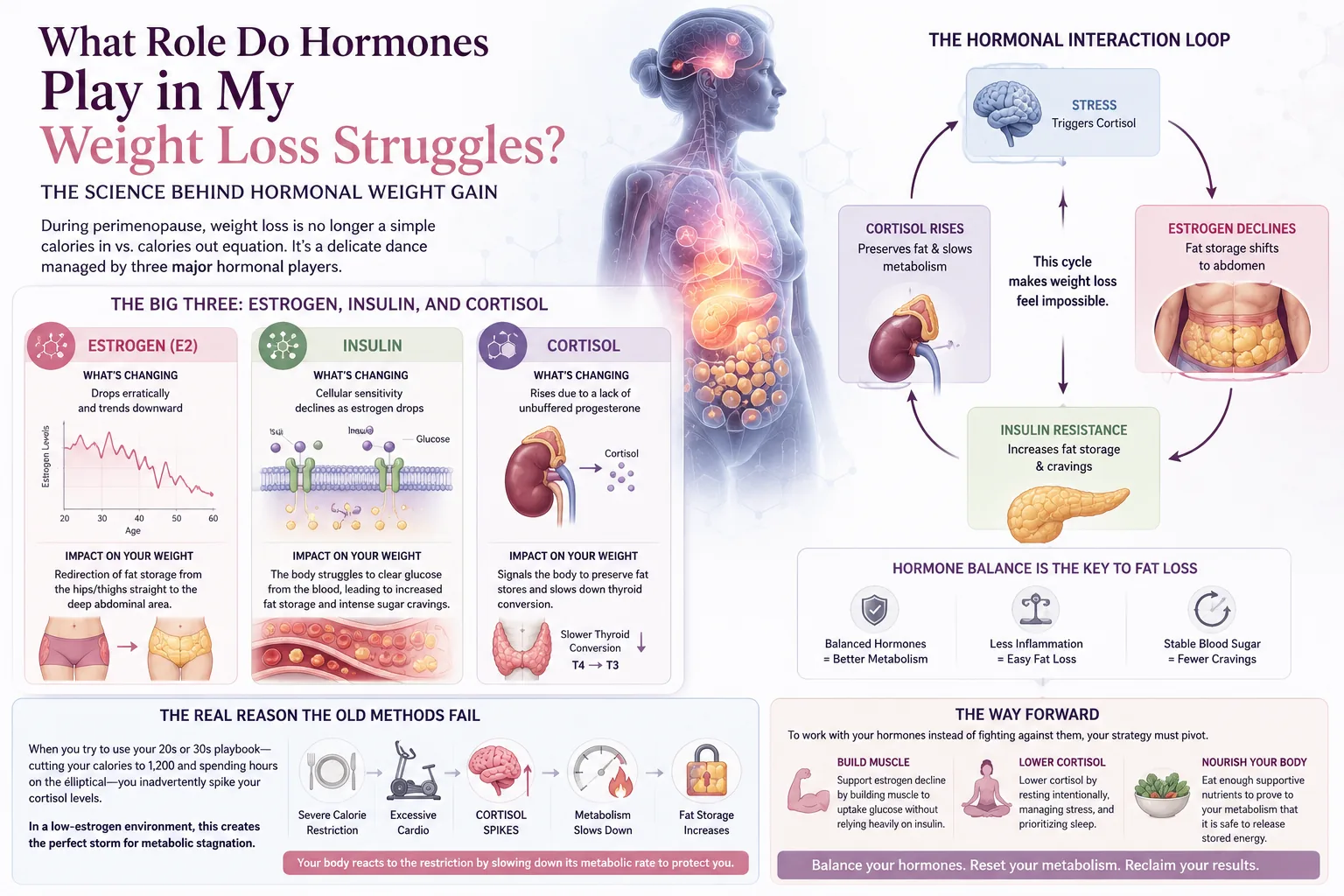
Here is the sentence that reorganizes everything once a woman truly hears it: your body does not count calories. It reads signals. Every bite you eat, every night you sleep, every stressful afternoon is translated into hormonal instructions, and those instructions, not your arithmetic, decide whether your body burns, stores, builds, or breaks down.
For twenty-some years, your hormonal signals were so favorable that calorie math seemed to work. Then the signals changed, the math stopped working, and everyone told you to do more math. So today, let me introduce you properly to the committee that actually runs your weight, because after 40, you are not negotiating with a calculator. You are negotiating with chemistry, and chemistry can be worked with once you know its names.
The Big Three: estrogen, insulin, and cortisol
Seven hormones sit on this committee, but three of them drive most of the perimenopause weight gain women feel first. If you remember nothing else, remember how these three shift and what that shift does to your body.
| Hormone | What is changing in perimenopause | The impact on your weight |
|---|---|---|
| Estrogen (E2) | Drops erratically and trends downward | Redirection of fat storage from the hips and thighs straight to the deep abdominal area. |
| Insulin | Cellular sensitivity declines as estrogen drops | The body struggles to clear glucose from the blood, leading to increased fat storage and intense sugar cravings. |
| Cortisol | Rises due to a lack of unbuffered progesterone | Signals the body to preserve fat stores and slows down thyroid conversion. |
Read that table twice, because it explains almost every frustration you have had this decade: why the fat moved to your middle, why the cravings got louder, and why the scale digs in even when you are doing everything right. Now let me introduce each committee member in full, including the four quieter voices that decide the rest.
Estrogen: the departing director
Estrogen spent decades quietly making weight management easier than you knew: keeping your cells sensitive to insulin, supporting your muscle, helping your brain hear its fullness signals, and directing fat toward hips and thighs rather than your middle. As it swings and declines through perimenopause, every one of those favors is withdrawn at once, which is why the same habits suddenly produce different results, and why the fat moved to a new address, as I mapped in the belly fat article. Estrogen is the reason "nothing changed but everything changed."
Progesterone: the lost buffer
Progesterone is your natural calming agent, the softener of stress and the friend of deep sleep, and it usually declines even before estrogen does. Its exit is why the same stress load lands harder now, why sleep frays, and why so many women feel wired and puffy in this season. Less progesterone means less shock absorption, and a body with less shock absorption spills more cortisol, which is exactly what the table above means by "unbuffered."
Cortisol: the storage foreman
Cortisol earns its place in the Big Three because chronically elevated, it orders central fat storage, keeps blood sugar high, demands dense food, slows thyroid conversion, and breaks down the muscle your metabolism depends on. In the after-40 committee, cortisol has the loudest voice, and it gets louder precisely because progesterone stopped moderating the meeting. I devote a full article to it in how stress affects weight loss after 40.
Insulin: the warehouse manager
Insulin decides where fuel goes: burned now, or stored for later. This season's rising insulin resistance means your body needs more insulin to do the same job, and a body swimming in insulin is a body holding the warehouse doors open. This is the hormone behind the 3 p.m. crashes, the carb math that stopped working in the carb article, and the stubbornness of midsection fat. The good news: insulin is also the most trainable member of the committee, responding within days to protein-anchored meals, strength work, walking, and sleep.
Thyroid: the thermostat
Your thyroid sets the idle speed of your entire metabolism, and midlife is exactly when it commonly begins to underperform in women, producing fatigue, cold hands, thinning hair, brain fog, and weight that will not move no matter what you do. Notice the connection from the table: rising cortisol slows the conversion of thyroid hormone into its active form, so a stress season can quietly throttle your thermostat. A struggling thyroid can silently cancel a perfect plan, which is why it is one of the first places we look, and why "normal" labs read for optimal matter so much.
Ghrelin and leptin: the appetite committee
Ghrelin says "eat." Leptin says "enough." You saw in the satiety article how this pair gets scrambled by falling estrogen and broken sleep, leaving you hungry after full meals. They are why hunger in this season is not a character measurement. It is a signal quality problem.
Testosterone: the forgotten ally
Yes, yours matters. Women's testosterone, modest but mighty, supports muscle, drive, and confidence, and it declines steadily through these years. Less of it means muscle is harder to keep, which shrinks your metabolic engine unless strength training deliberately defends it. It is the committee member nobody mentions to women, and its quiet decline is part of why lifting becomes non-negotiable now.
How you actually negotiate with the committee
Notice something remarkable: the same short list speaks to every hormone above. Strength training raises insulin sensitivity, defends testosterone's muscle, and counters cortisol. Protein-anchored, fiber-rich meals calm insulin and satisfy leptin's scrambled signals. Guarded sleep resets ghrelin, lowers cortisol, and gives every repair hormone its night shift. Managed stress stops the foreman from overriding everyone else, and protects your thyroid conversion in the bargain. This is why the BloomHer approach is not a pile of hacks. It is one coherent conversation held in your body's actual language, and I go deeper on the whole system on our hormone balance page.
But here is the part I will not let you skip: you cannot negotiate with a committee you have never met. Comprehensive lab testing read for optimal, not merely normal, shows us your actual thyroid, your actual insulin picture, your actual deficiencies, so we treat your reality instead of your demographic. Working practitioner-led through BloomHer, alongside your primary care doctor and our network provider, your method, ShapeUp as the foundation, Fire inside Radiance, Butter inside Full Bloom, is matched to what your labs and your data say, tracked through your foods, weight, moods, and sleep cycles in the BloomHer membership app, and adjusted the moment your body changes its mind. I also walk through every hormone and every era of a woman's health in my book, Let Her Bloom in Health.
So what role do hormones play in weight loss after 40? The lead role. Every other character, calories, workouts, willpower, reads their lines to the committee. Learn its names, speak its language, test instead of guess, and the body that seemed to stop cooperating turns out to have been waiting for you to change the conversation.