
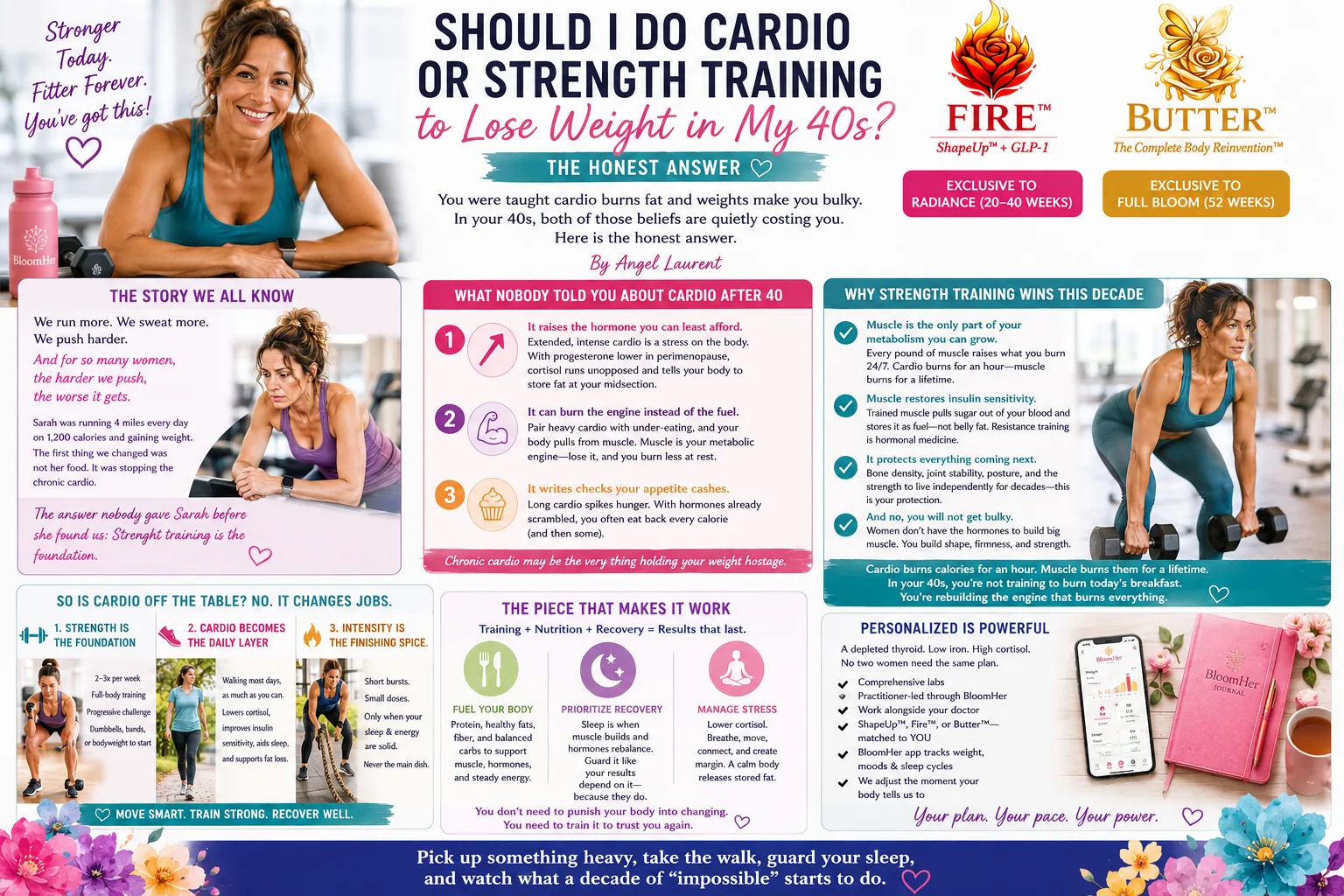
Every woman my age was raised on the same fitness gospel: cardio burns fat, and the sweatier the better. So when the weight starts climbing in our forties, we do what we were trained to do. We run more. We add another spin class. We push harder.
And for so many women, the harder they push, the worse it gets.
If that is where you are, I want to give you the answer nobody gave Sarah before she found us: in your 40s, strength training is the foundation, and chronic cardio may be the very thing holding your weight hostage. Let me show you why.
What nobody told you about cardio after 40
Cardio is not bad. Your heart loves it, your mood loves it, and it absolutely burns calories while you are doing it. But for a woman in perimenopause, long, hard, frequent cardio has three costs that were never on the label.
It raises the hormone you can least afford. Extended, intense cardio is a stress on the body, and stress means cortisol. In your thirties, progesterone buffered that stress. Now progesterone has fallen, cortisol runs unopposed, and elevated cortisol tells your body to store fat at your midsection. Daily punishing cardio on top of a stressful life is not fat-burning. It is alarm-ringing.
It can burn the engine instead of the fuel. Pair heavy cardio with under-eating, the classic combination, and your body starts pulling from muscle. Muscle is your metabolic engine, as I explained in why your metabolism slowed. Lose it, and every day for the rest of your life you burn less at rest.
It writes checks your appetite cashes. Long cardio sessions reliably spike hunger. With leptin and ghrelin already scrambled by perimenopause, a hard hour of cardio often ends in eating back every calorie and then some, while feeling virtuous doing it.
This is exactly what happened to Sarah, who was running four miles every single day on 1,200 calories and gaining weight around her middle. The first thing we changed was not her food. It was stopping the chronic cardio.
Why strength training wins this decade
Strength training is the single most powerful physical investment a woman over 40 can make, and it is not close.
Muscle is the only part of your metabolism you can grow. Every pound of lean muscle you build raises what you burn around the clock, awake and asleep. Cardio burns calories for an hour. Muscle burns them for a lifetime.
Muscle restores insulin sensitivity. This is the quiet superpower. Trained muscle pulls sugar out of your bloodstream and stores it as ready fuel instead of belly fat, directly pushing back against the insulin resistance that perimenopause created. Resistance training is, quite literally, hormonal medicine.
It protects everything coming next. Bone density, joint stability, posture, the strength to live independently for decades: all of it is built in this window. Estrogen was quietly protecting your bones, and as it leaves, resistance becomes the protection.
And no, you will not get bulky. Women do not have the hormonal machinery to accidentally build big muscle. What you build instead is shape, the firmness women chase with cardio for years and never find, because it was never on the treadmill.
So is cardio off the table? No. It changes jobs.
Here is your new hierarchy. Strength is the foundation: structured resistance training two to three times a week, the same prescription that turned Sarah around. Full-body sessions, progressively challenging, with dumbbells, bands, or your own bodyweight to start.
Cardio becomes the gentle, daily layer: walking, most days, as much as your life allows. Walking lowers cortisol instead of spiking it, improves insulin sensitivity, aids sleep, and costs your body nothing to recover from. It is the most underrated fat-loss tool in a midlife woman's toolbox.
Then, only once your sleep and energy are solid, short bursts of higher intensity can come back in small doses. Brief and occasional is the key, a finishing spice, never the main dish it used to be.
The piece that makes it work: recovery and the right plan
Muscle is not built during the workout. It is built during sleep, out of protein. So this only works as a system: the training, the plate I gave you in what to eat in perimenopause, and the evening wind-down that lowers cortisol and repairs your sleep.
And like everything at this stage of life, the exact dose is personal. A woman with depleted iron, a struggling thyroid, or cortisol running high around the clock needs a different starting point than her neighbor, which is why we begin with comprehensive labs and build from there. Working practitioner-led through BloomHer, alongside your primary care doctor and our network provider, we match your movement plan to your method, ShapeUp, Fire, or Butter, track your weight, moods, and sleep cycles in the BloomHer membership app, and adjust the moment your body tells us to, following our exclusive Dry Sponge Method.
You do not need to punish your body into changing. You need to train it to trust you again. Pick up something heavy, take the walk, guard your sleep, and watch what a decade of "impossible" starts to do.