
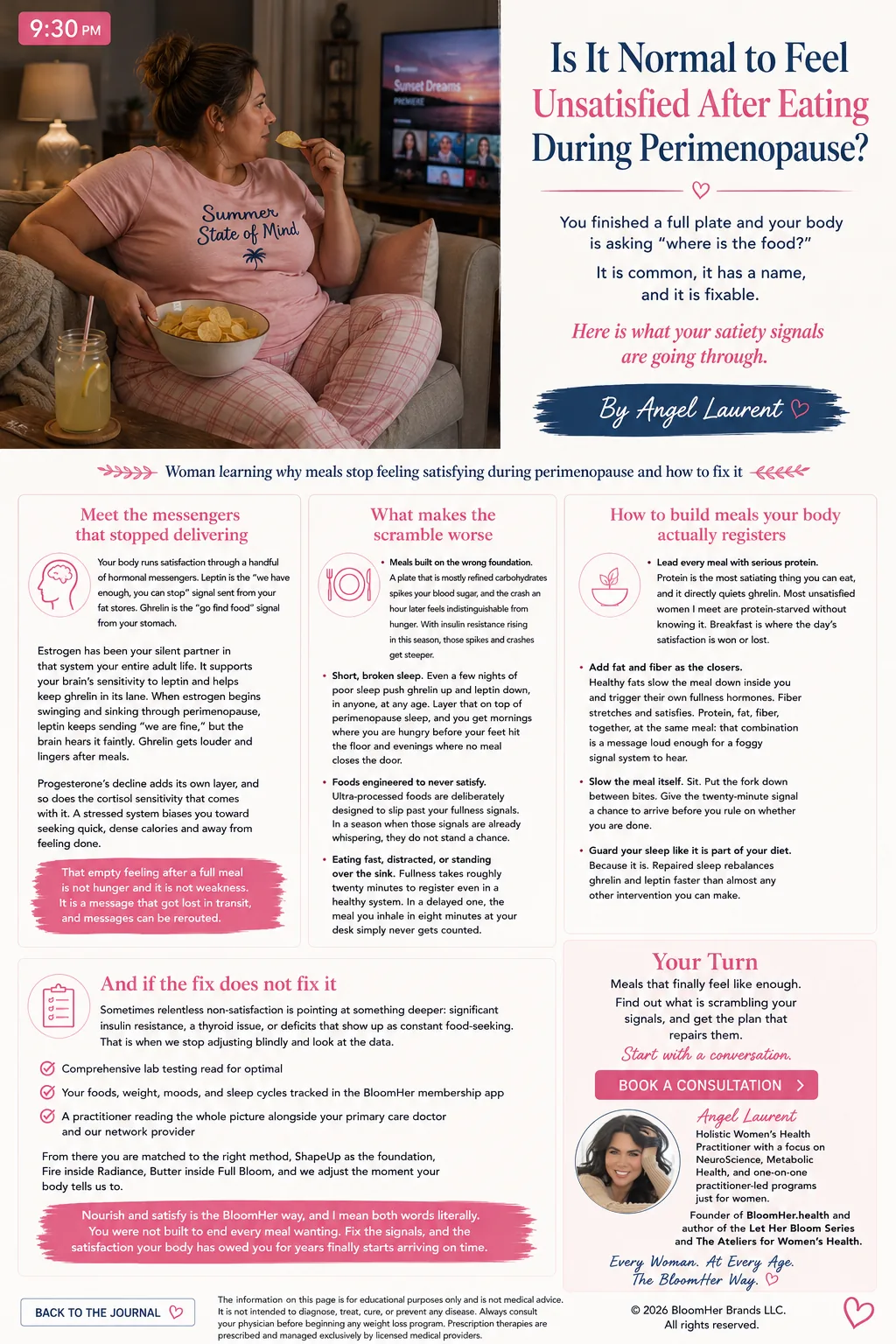
It is one of the strangest feelings in this whole transition, and women describe it to me almost sheepishly, as if confessing: "I eat a full dinner, a real dinner, and twenty minutes later I am staring into the refrigerator like I never ate at all."
Then comes the question, quietly: "Is that normal? Or is something wrong with me?"
Here is my answer, and I want you to hear both halves of it. Yes, it is extremely common in perimenopause, so common that I consider it one of the signature symptoms almost nobody warns women about. And no, it is not something you have to live with, because that unsatisfied feeling is not hunger, not greed, and not weakness. It is a signaling problem. Your fullness messages are being scrambled in transit, and scrambled signals can be repaired.
Meet the messengers that stopped delivering
Your body runs satisfaction through a handful of hormonal messengers. Leptin is the "we have enough, you can stop" signal sent from your fat stores. Ghrelin is the "go find food" signal from your stomach. A well-run system raises ghrelin before meals, drops it after, and lets leptin quietly confirm that all is well.
Estrogen has been your silent partner in that system your entire adult life. It supports your brain's sensitivity to leptin and helps keep ghrelin in its lane, which is one reason appetite often feels more manageable in the higher-estrogen weeks of a normal cycle. When estrogen begins swinging and sinking through perimenopause, that support wobbles. Leptin keeps sending "we are fine," but the brain hears it faintly. Ghrelin gets louder and lingers after meals. The result is exactly what you have been living: a body that has eaten and a brain that did not fully get the memo.
Progesterone's decline adds its own layer, and so does the cortisol sensitivity that comes with it. A stressed system biases you toward seeking quick, dense calories and away from feeling done. This is the same scrambled-signal story I touched on in what causes perimenopause belly fat, because the hormones that misfile your fullness are the same ones redirecting your fat storage.
What makes the scramble worse
Meals built on the wrong foundation. A plate that is mostly refined carbohydrates spikes your blood sugar, and the crash an hour later feels indistinguishable from hunger. With insulin resistance rising in this season, those spikes and crashes get steeper, so the same pasta dinner that held you at 35 abandons you at 47.
Short, broken sleep. Even a few nights of poor sleep push ghrelin up and leptin down, in anyone, at any age. Layer that on top of perimenopause sleep, and you get mornings where you are hungry before your feet hit the floor and evenings where no meal closes the door.
Foods engineered to never satisfy. Ultra-processed foods are deliberately designed to slip past your fullness signals. In a season when those signals are already whispering, they do not stand a chance.
Eating fast, distracted, or standing over the sink. Fullness takes roughly twenty minutes to register even in a healthy system. In a delayed one, the meal you inhale in eight minutes at your desk simply never gets counted.
How to build meals your body actually registers
The repair is wonderfully practical, and it is the same plate I built for you in what to eat in perimenopause, because satiety and fat loss run on the same chemistry.
Lead every meal with serious protein. Protein is the most satiating thing you can eat, and it directly quiets ghrelin. Most unsatisfied women I meet are protein-starved without knowing it. Breakfast is where the day's satisfaction is won or lost: a protein-anchored morning changes how the entire day's hunger behaves.
Add fat and fiber as the closers. Healthy fats slow the meal down inside you and trigger their own fullness hormones. Fiber stretches and satisfies. Protein, fat, fiber, together, at the same meal: that combination is a message loud enough for a foggy signal system to hear.
Slow the meal itself. Sit. Put the fork down between bites. Give the twenty-minute signal a chance to arrive before you rule on whether you are done. It sounds almost too simple, and my clients are consistently shocked at how much of their "insatiable" feeling was a timing problem.
Guard your sleep like it is part of your diet. Because it is. Repaired sleep rebalances ghrelin and leptin faster than almost any other intervention you can make.
And if the fix does not fix it
Sometimes relentless non-satisfaction is pointing at something deeper: significant insulin resistance, a thyroid issue, or deficits that show up as constant food-seeking. That is when we stop adjusting blindly and look at the data. Comprehensive lab testing read for optimal, your foods, weight, moods, and sleep cycles tracked in the BloomHer membership app, and a practitioner reading the whole picture alongside your primary care doctor and our network provider. From there you are matched to the right method, ShapeUp as the foundation, Fire inside Radiance, Butter inside Full Bloom, and we adjust the moment your body tells us to.
Nourish and satisfy is the BloomHer way, and I mean both words literally. You were not built to end every meal wanting. Fix the signals, and the satisfaction your body has owed you for years finally starts arriving on time.