
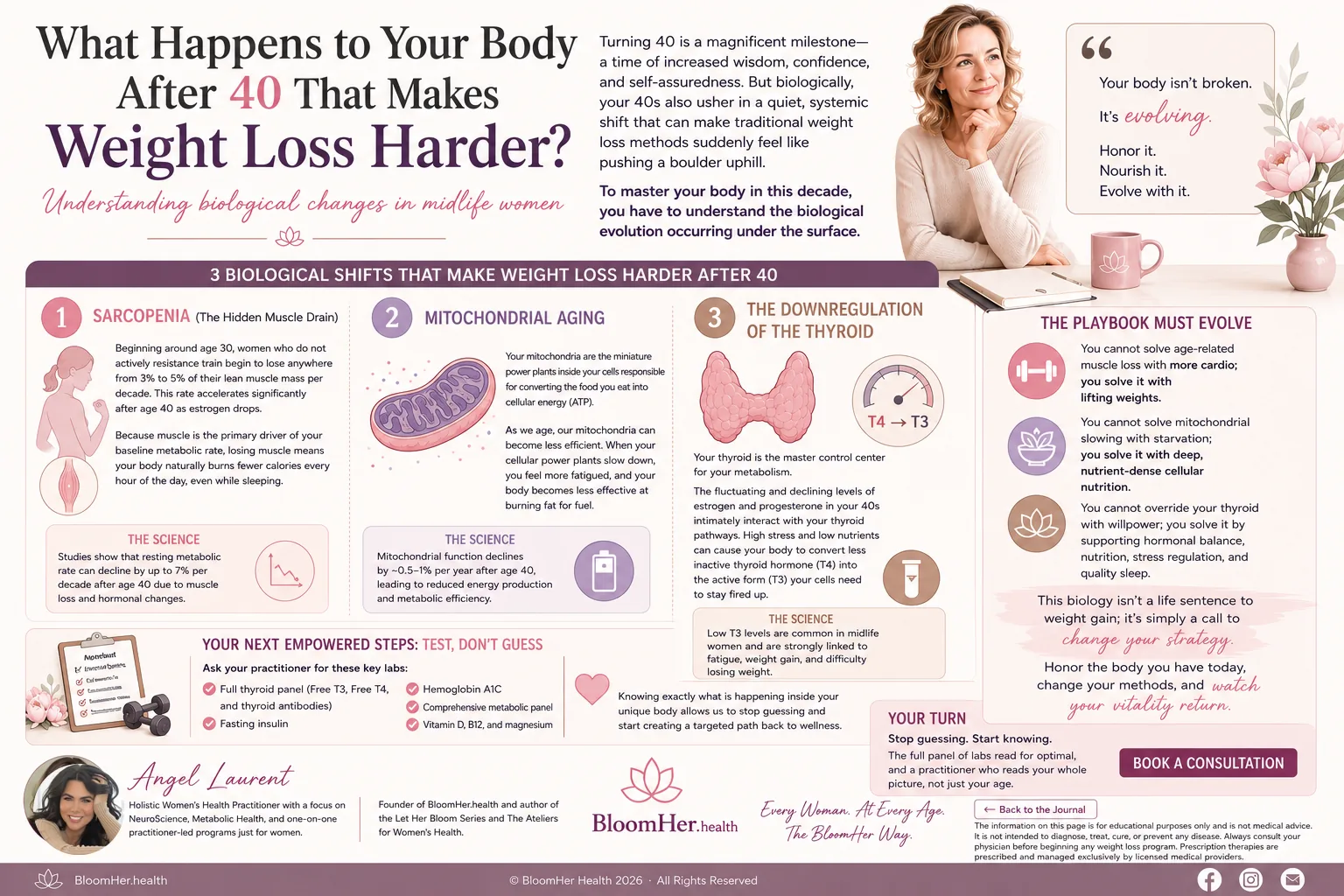
Turning 40 is a magnificent milestone, a time of increased wisdom, confidence, and self-assuredness. But biologically, your 40s also usher in a quiet, systemic shift that can make traditional weight loss methods suddenly feel like pushing a boulder uphill.
To master your body in this decade, you have to understand the biological evolution occurring under the surface. Once you see the three changes at work, the "why is this suddenly so hard" mystery dissolves, and a smarter strategy takes its place.
1. Sarcopenia, the hidden muscle drain
Beginning around age 30, women who do not actively resistance train begin to lose anywhere from 3% to 5% of their lean muscle mass per decade. This rate accelerates significantly after age 40 as estrogen drops. Because muscle is the primary driver of your baseline metabolic rate, losing muscle means your body naturally burns fewer calories every hour of the day, even while sleeping. This is the quiet engine shrinkage I first described in why your metabolism slowed, and it is the single most reversible of the three.
2. Mitochondrial aging
Your mitochondria are the miniature power plants inside your cells responsible for converting the food you eat into cellular energy, called ATP. As we age, our mitochondria can become less efficient. When your cellular power plants slow down, you feel more fatigued, and your body becomes less effective at burning fat for fuel. This is a real part of why the exhaustion in why am I always tired is not in your head. It is in your cells.
3. The downregulation of the thyroid
Your thyroid is the master control center for your metabolism. The fluctuating and declining levels of estrogen and progesterone in your 40s intimately interact with your thyroid pathways. High stress and low nutrients can cause your body to convert less inactive thyroid hormone (T4) into the active form (T3) your cells need to stay fired up. It is the same cortisol-throttles-thyroid link I flagged in the hormones article, and it is exactly why we look at Free T3, not just TSH.
The playbook must evolve
This biology is not a life sentence to weight gain; it is simply a call to change your strategy. Notice how each change points to its own remedy:
- You cannot solve age-related muscle loss with more cardio. You solve it with lifting weights, the case I made in cardio versus strength and dumbbells versus bodyweight.
- You cannot solve mitochondrial slowing with starvation. You solve it with deep, nutrient-dense cellular nutrition, the abundant plate from losing weight without deprivation.
- You cannot solve a downregulated thyroid by guessing. You solve it by testing, reading the right markers, and correcting the stress and nutrient gaps underneath.
This is the whole reason BloomHer is built the way it is. Working practitioner-led, alongside your primary care doctor and our network provider, we begin with comprehensive lab testing read for optimal to see your actual muscle, mitochondrial, and thyroid picture, then build your method, ShapeUp as the foundation, Fire inside Radiance, Butter inside Full Bloom, to answer your specific biology, tracking your foods, weight, moods, and sleep cycles in the BloomHer membership app so your strategy evolves exactly as your body does.
Honor the body you have today, change your methods, and watch your vitality return. Your 40s did not break your body. They simply changed the rules of the game, and a woman who learns the new rules does not just keep up. She wins.