
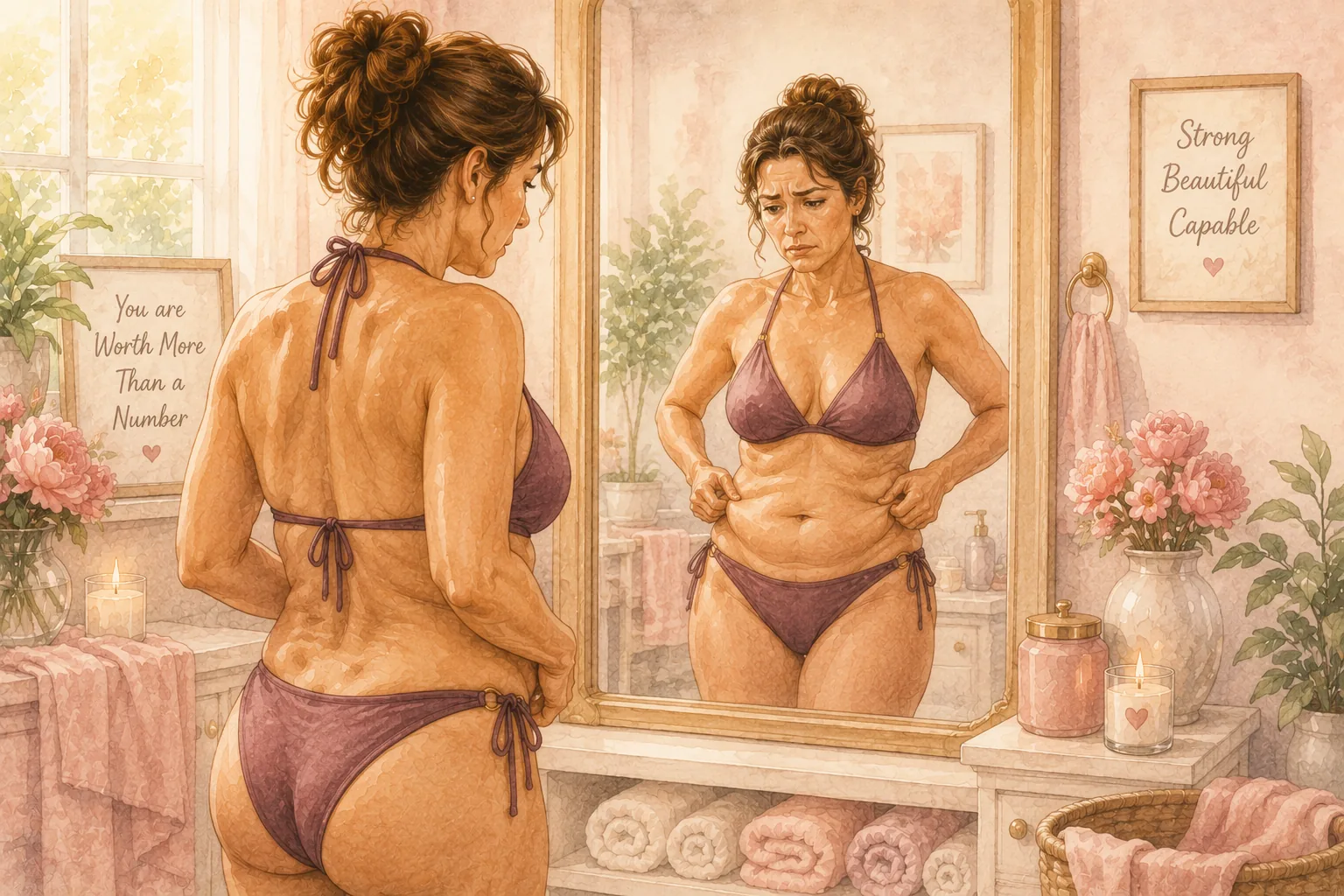
It is one of the most frustrating experiences in midlife: you have worked hard, the scale shows that you have dropped 5 or 10 pounds, but when you go to zip up your favorite pair of pants, they still feel uncomfortably tight around your waist.
What gives? The answer lies in a phenomenon called body recomposition and the way hormonal shifts alter where your body stores fat. Once you understand it, the mystery dissolves, and so does the discouragement.
The great migration of fat storage
When your estrogen levels are high and healthy during your youth, your body naturally routes excess energy to subcutaneous fat stores, the fat located just beneath the skin, primarily around your hips, thighs, and buttocks.
As estrogen drops during perimenopause, your body's fat distribution blueprint changes. It begins routing fat away from your lower body and depositing it deep within your abdominal cavity as visceral fat. Visceral fat wraps around your internal organs and expands your waistline, even if your total weight remains unchanged. This is the same great migration I mapped in what causes perimenopause belly fat: the fat did not necessarily increase, it relocated, and it relocated to the one place guaranteed to change how your pants fit.
The muscle loss factor
Additionally, if you lost those 10 pounds through intense calorie restriction or pure cardio, a significant portion of that lost weight likely came from lean muscle tissue rather than fat. This is the hidden cost of the crash-diet approach I warned about in does eating less actually work.
- If you lose muscle, your body becomes less firm and your metabolism slows down.
- You end up with a smaller version of the exact same body composition, meaning your clothes still pinch at the waist.
Read that second point again, because it is the quiet tragedy of scale-only dieting: you can successfully shrink and still be exactly the same shape, just tighter-fitting, softer, and with a slower metabolism than when you started. The number went down. The problem did not.
How to change the fit of your clothes
To shift your shape and pull your waistline back in, stop chasing a lower number on the scale and start focusing on your muscle-to-fat ratio. Three moves do it:
Lift weights to preserve and build your muscle architecture. Muscle is what firms your body and holds your shape, and it is the only lever that reverses the recomposition, exactly the case I made in dumbbells versus bodyweight. Every pound of muscle you keep is a pound your metabolism keeps too.
Eat sufficient protein to repair that tissue. You cannot build or defend muscle without the raw material, which is why I hold women to 25 to 30 grams per meal in the protein article. Protein is the difference between losing fat and losing yourself.
Manage stress to reduce the cortisol spikes that feed visceral belly fat. Remember from the stress article that cortisol specifically fuels the visceral fat sitting at your waistline, so calming your stress is a direct waistline strategy, not a vague wellness suggestion.
Do those three things and your clothes will thank you, often long before the scale gives you full credit. This is precisely why I begged you to stop worshipping the scale in how often should you weigh yourself: the tape measure and the fit of your jeans are telling you the truth the scale keeps hiding.
How we do it with you
Body recomposition is measurable, and we measure it. Working practitioner-led through BloomHer, alongside your primary care doctor and our network provider, we begin with comprehensive lab testing read for optimal, track your foods, weight, moods, and sleep cycles in the BloomHer membership app, and watch inches, energy, and strength alongside weight so we can see your shape changing even when the scale is being stubborn. Your method, ShapeUp as the foundation, Fire inside Radiance, Butter inside Full Bloom, is built to defend muscle while releasing visceral fat, which is the entire point.
So the next time your pants feel tight after a good month, do not despair, and do not starve harder, which only makes it worse. Build muscle, feed it well, lower your stress, and let your body change its architecture. The scale was always the wrong judge. Your favorite jeans are about to become the right one.