
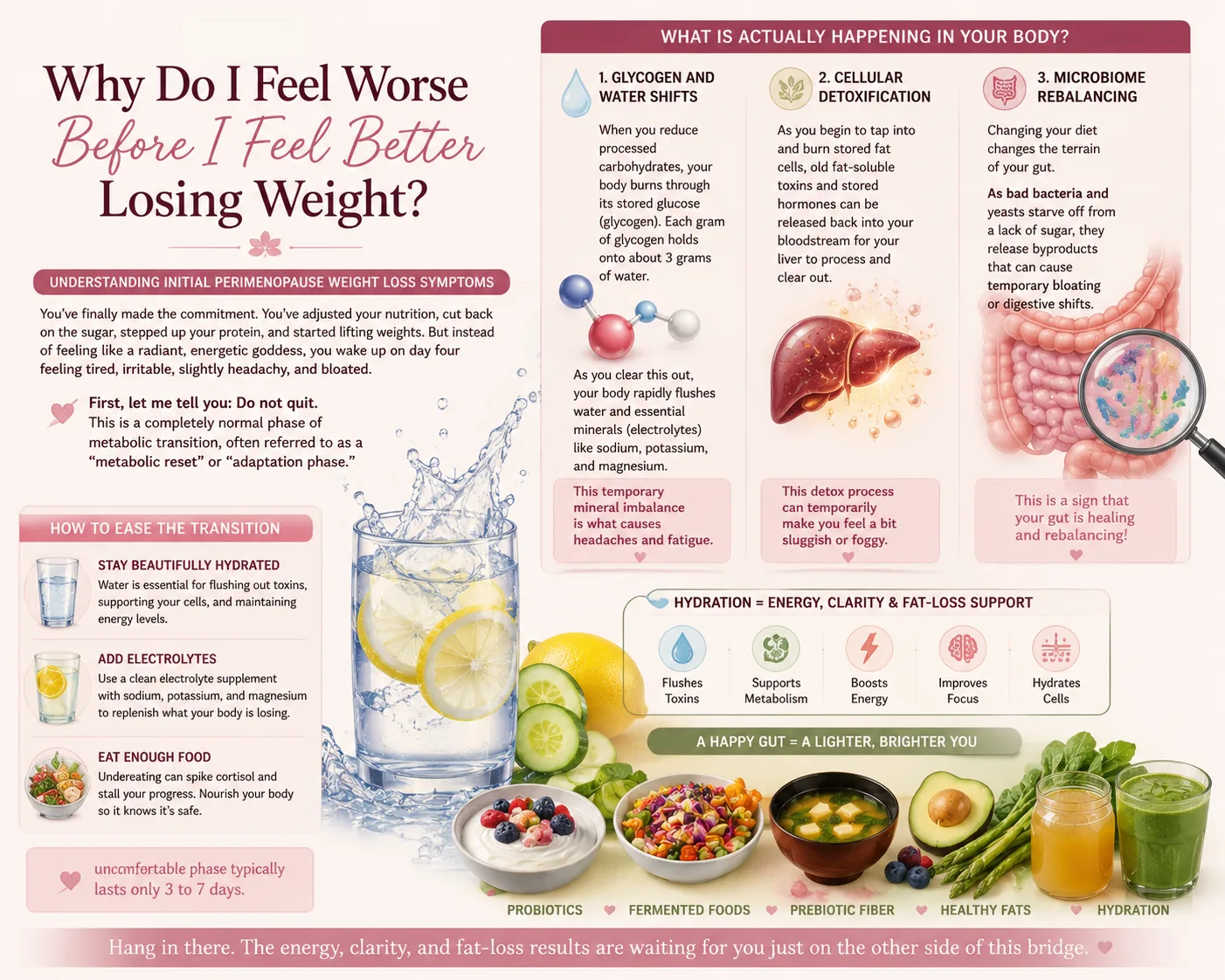
You have finally made the commitment. You have adjusted your nutrition, cut back on the sugar, stepped up your protein, and started lifting weights. But instead of feeling like a radiant, energetic goddess, you wake up on day four feeling tired, irritable, slightly headachy, and bloated.
First, let me tell you: do not quit. This is a completely normal phase of metabolic transition, often referred to as a "metabolic reset" or "adaptation phase." I promised you in how long weight loss takes that the first weeks are an adaptation, and this is what that adaptation can feel like on the inside. It is not the plan failing. It is the plan beginning.
What is actually happening in your body?
When your body has been accustomed to a certain way of eating, especially if your previous diet was higher in processed foods, quick carbohydrates, or chronic caffeine, shifting to a hormone-supportive lifestyle requires your cells to undergo major adaptations.
- Glycogen and water shifts: When you reduce processed carbohydrates, your body burns through its stored glucose, called glycogen. Each gram of glycogen holds onto about 3 grams of water. As you clear this out, your body rapidly flushes water and essential minerals, the electrolytes like sodium, potassium, and magnesium. This temporary mineral imbalance is what causes the headaches and fatigue. It is also, by the way, why the scale can drop dramatically in week one and then slow down, exactly the fluctuation I explained in how often to weigh yourself.
- Cellular detoxification: As you begin to tap into and burn stored fat cells, old fat-soluble toxins and stored hormones can be released back into your bloodstream for your liver to process and clear out, temporarily making you feel a bit sluggish or foggy.
- Microbiome rebalancing: Changing your diet changes the terrain of your gut. As bad bacteria and yeasts starve off from a lack of sugar, they release byproducts that can cause temporary bloating or digestive shifts.
How to ease the transition
This uncomfortable phase typically lasts only 3 to 7 days. You can support your body through it:
- Stay beautifully hydrated, since so much of the misery is simply the water and mineral flush.
- Add a clean electrolyte supplement to your water, to replace the sodium, potassium, and magnesium you are losing. This one step resolves most of the headaches and fatigue faster than anything else.
- Ensure you are eating enough food, so your body does not mistake the transition for a crisis and dig in the way I described in does eating less actually work. Adaptation is not the time to also slash your intake.
When it is adaptation, and when it is not
Here is where practitioner guidance matters. A few days of mild fog, headache, and bloating that lift with hydration and electrolytes is textbook adaptation. But symptoms that are severe, or that drag on well past a week, deserve a second look, because they can point to something else: a thyroid issue, a deeper deficiency, or a plan that cut too hard, too fast. This is exactly why we do not send women off to white-knuckle it alone. Working practitioner-led through BloomHer, alongside your primary care doctor and our network provider, we start with comprehensive lab testing read for optimal, ease you into your method, ShapeUp as the foundation, Fire inside Radiance, Butter inside Full Bloom, at a pace your body can handle, and track your foods, weight, moods, and sleep cycles in the BloomHer membership app so we can tell the difference between normal adaptation and a signal that needs attention. You should never have to guess whether feeling bad is part of the plan or a warning.
Hang in there. The energy, clarity, and fat-loss results are waiting for you just on the other side of this bridge. Day four is not the wall. It is the doorway, and almost every woman who pushed gently through it tells me the same thing: I am so glad I did not quit on the day it was about to start working.