
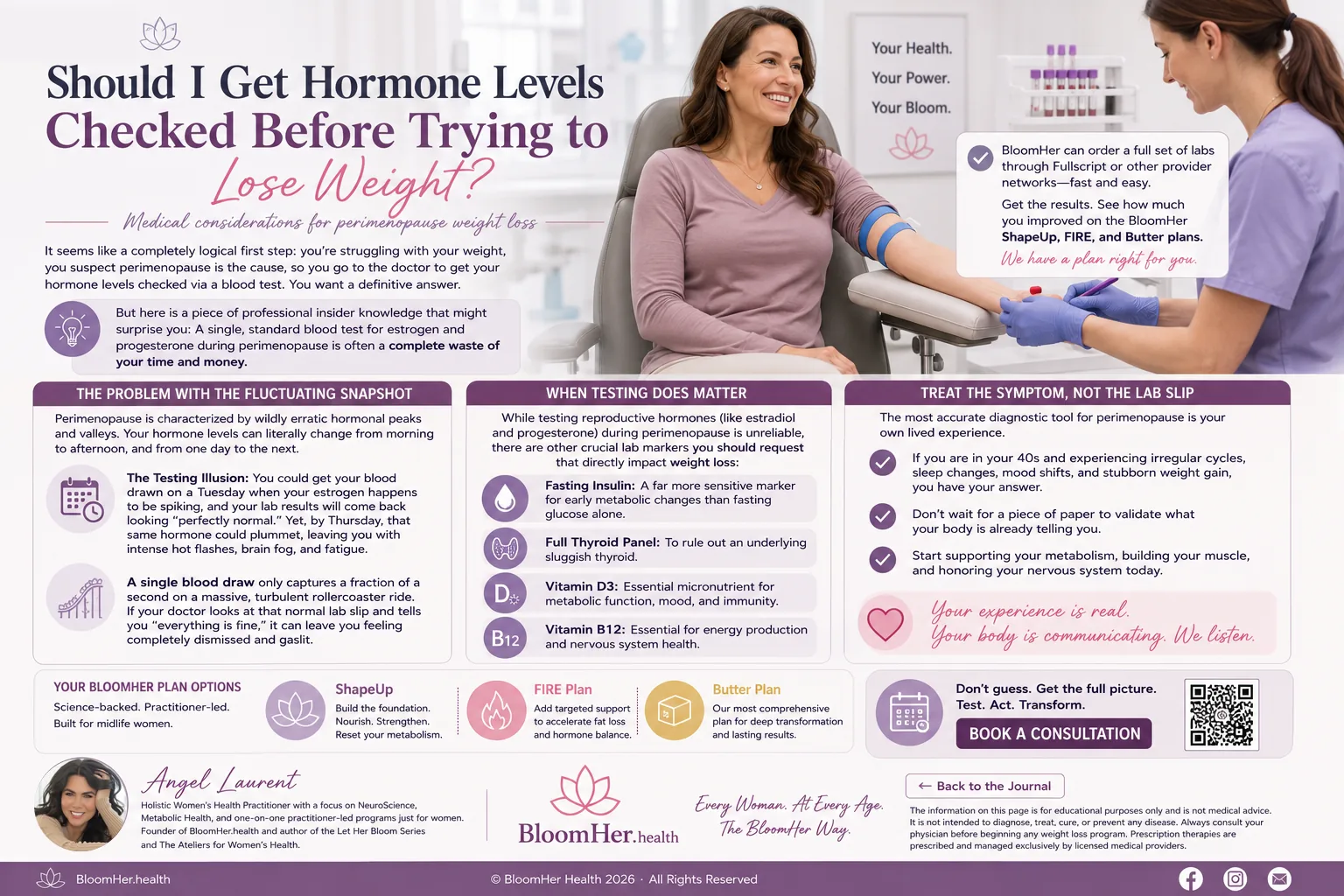
It seems like a completely logical first step: you are struggling with your weight, you suspect perimenopause is the cause, so you go to the doctor to get your hormone levels checked via a blood test. You want a definitive answer.
But here is a piece of professional insider knowledge that might surprise you: a single, standard blood test for estrogen and progesterone during perimenopause is often a complete waste of your time and money.
The problem with the fluctuating snapshot
Perimenopause is characterized by wildly erratic hormonal peaks and valleys. Your hormone levels can literally change from morning to afternoon, and from one day to the next.
The testing illusion: you could get your blood drawn on a Tuesday when your estrogen happens to be spiking, and your lab results will come back looking "perfectly normal." Yet by Thursday, that same hormone could plummet, leaving you with intense hot flashes, brain fog, and fatigue.
A single blood draw only captures a fraction of a second on a massive, turbulent rollercoaster ride. If your doctor looks at that normal lab slip and tells you "everything is fine," it can leave you feeling completely dismissed and gaslit, the exact experience I wrote about in why doctors do not take your weight gain seriously.
When testing does matter
While testing reproductive hormones like estradiol and progesterone during perimenopause is unreliable, there are other crucial lab markers you should request that directly impact weight loss:
- Fasting insulin: a far more sensitive marker for early metabolic changes than fasting glucose alone. It often reveals a problem years before glucose does.
- Full thyroid panel: to rule out an underlying sluggish thyroid, including Free T3 and Free T4, not just TSH.
- Vitamin D3 and B12: essential micronutrients for metabolic function and energy production, and two of the most common quiet deficiencies in midlife women.
This is the crucial distinction: we do not chase the unreliable reproductive-hormone snapshot, we test the stable, actionable markers that actually change your plan. It is exactly the panel I pointed to in is my weight gain just perimenopause, and it is what comprehensive lab testing read for optimal is built around.
Treat the symptom, not the lab slip
The most accurate diagnostic tool for perimenopause is your own lived experience. If you are in your 40s and experiencing irregular cycles, sleep changes, mood shifts, and stubborn weight gain, you have your answer. Do not wait for a piece of paper to validate what your body is already telling you.
Start supporting your metabolism, building your muscle, and honoring your nervous system today. Working practitioner-led through BloomHer, alongside your primary care doctor and our network provider, we read the markers that matter, listen to the symptoms that matter more, and build your method, ShapeUp as the foundation, Fire inside Radiance, Butter inside Full Bloom, around your real, lived body, tracking your foods, weight, moods, and sleep cycles in the BloomHer membership app so your progress is measured by how you actually feel and function, not by one number on one slip of paper.
So should you get your hormones checked before losing weight? Get the useful labs, skip the misleading ones, and above all, believe your body. You do not need a lab to give you permission to feel better. You need a plan that starts today.