
Women usually ask me this question in a very specific tone. It is half practical, half bracing for impact, the way you might ask how bad a storm is going to be. "How much should I expect to gain? Five pounds? Ten? Should I just buy the bigger clothes now?"
I love this question, because it is really two questions wearing one coat. There is "what typically happens to women's bodies in this transition," which deserves an honest answer. And underneath it there is "how much of this is mandatory," which deserves an even better one.
The honest answer: what typically happens
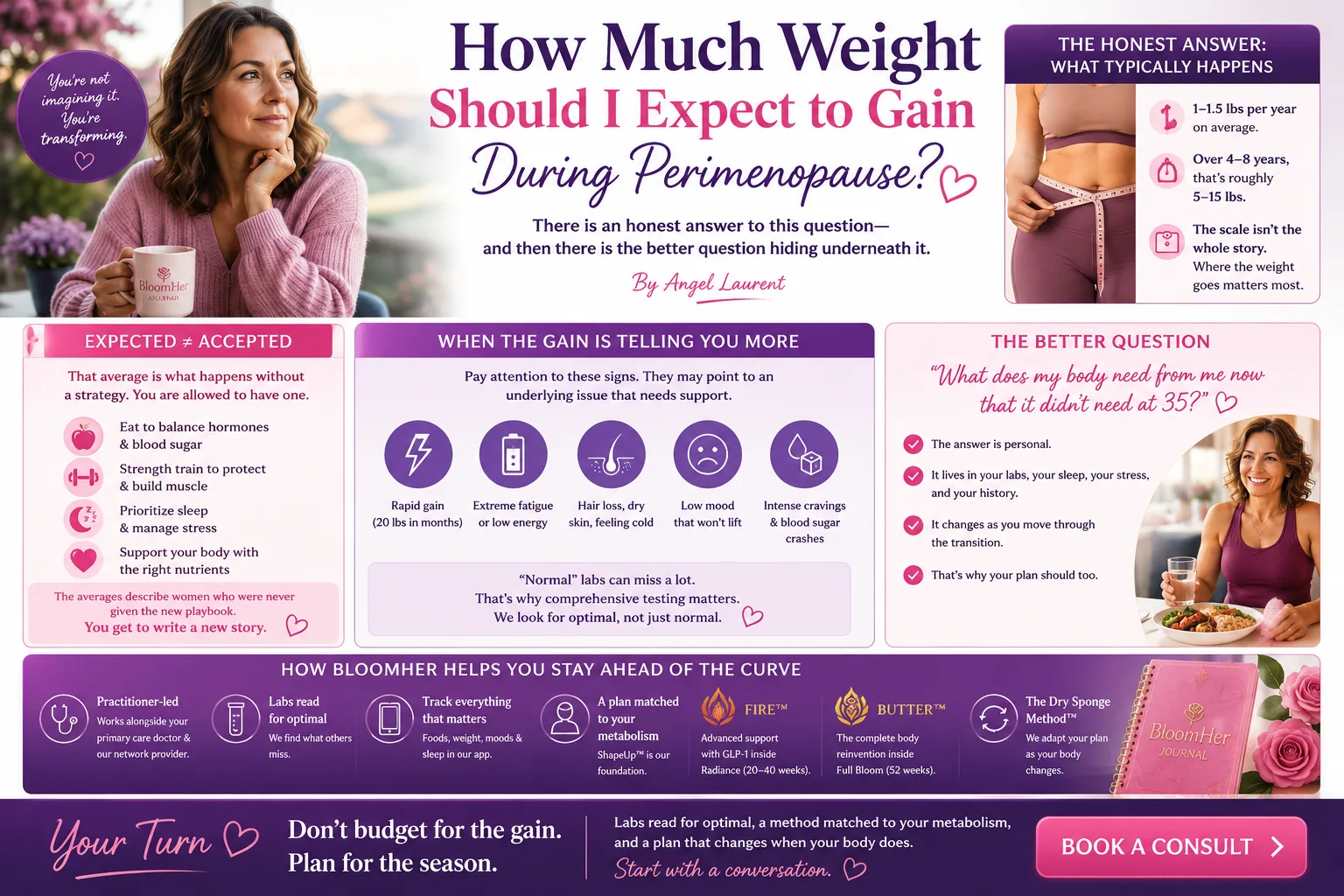
On average, women gain somewhere in the neighborhood of a pound to a pound and a half per year through the menopause transition, which usually spans four to eight years. So a woman might see five, ten, or fifteen pounds accumulate across her perimenopause if nothing about her approach changes. Some women see more, some less, and genetics, stress, sleep, and lifestyle all move the number.
But the scale is honestly the least interesting part of the story. The bigger change is where the weight goes and what it is made of. Even women whose weight barely moves often watch their shape change: waistbands tighten while the number holds steady. That is because declining estrogen shifts fat storage away from hips and thighs and toward the midsection, at the same time as muscle quietly declines, the shift I unpacked in why your metabolism slowed. Less muscle, more visceral fat, same scale weight: the composition changed underneath you.
So if you have gained eight or ten pounds across a few years and your body feels different at the waist, you are living the textbook pattern. You are normal. Nothing is wrong with you. Now for the part I actually need you to hear.
"Expected" does not mean "accepted"
Those averages describe what happens to women who keep running their old playbook while the rules change underneath them, eating the same way, moving the same way, sleeping the same way, while insulin resistance rises, cortisol runs less opposed, and muscle slips away. The gain is the default outcome, not the destiny.
I watch women beat that average every single week, not by fighting harder inside the old rules, but by switching playbooks: anchoring meals in protein like I showed you in what to eat in perimenopause, trading punishing cardio for strength like Sarah did in her story, guarding sleep, and managing cortisol on purpose. The average is what happens without a strategy. You are allowed to have a strategy.
When the gain is telling you something more
Now, the flip side, because it matters just as much. Some weight gain in this season is not the ordinary hormonal drift, and it deserves investigation instead of acceptance.
Pay attention if the gain is rapid, twenty pounds in months rather than years, especially without any change in how you eat or move. Pay attention if it travels with heavy fatigue, hair loss, feeling cold, dry skin, or a low mood that will not lift, the fingerprints of a struggling thyroid. Pay attention if it comes with intense cravings, energy crashes after meals, and skin changes that hint at deeper insulin resistance. These patterns hide easily inside "it's just perimenopause," and as I wrote in why doctors dismiss weight gain, a brief normal-looking panel can miss every one of them. This is exactly why we start every woman with comprehensive lab testing read for optimal, not just normal. The scale is data. But it is the labs that tell us what the scale means.
So here is the better question
Instead of "how much should I expect to gain," ask "what does my body need from me now that it did not need at 35?" That question has a real answer, and it is personal to you. It lives in your labs, your sleep, your stress, and your history, and it changes as you move through the transition, which is why everything we do at BloomHer is practitioner-led, works alongside your primary care doctor and our network provider, and adapts continuously. Your foods, weight, moods, and sleep cycles are tracked in the BloomHer membership app, you are matched to the right method for your metabolism, ShapeUp as the foundation, or our advanced methods, Fire inside Radiance and Butter inside Full Bloom, and our exclusive Dry Sponge Method tells us the moment your body is ready for the next step.
Plan for the transition the way you would plan for any season: informed, equipped, and unafraid. Some change in this decade is real and normal. But the fifteen quiet pounds everyone told you to expect? Those were never a requirement. They were just what happens when nobody hands a woman the new playbook. Consider it handed.